Squid Empire by Danna Staaf
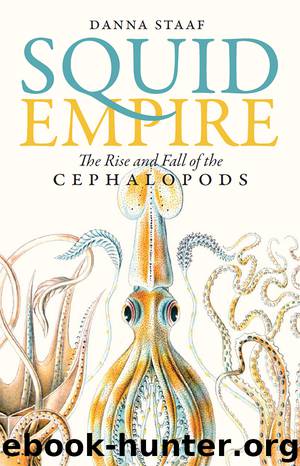
Author:Danna Staaf
Language: eng
Format: epub
Publisher: University Press of New England
Fossils in History: From Fishing Fields to Buffalo Stones
People have noticed fossils of shelled cephalopods all over the world since ancient times, but soft-bodied fossils have been much harder to come by. They depend on the formation of Lagerstätte—German for “storage place,” this term refers to a rock bed with phenomenal fossil preservation. (The drinkable kind of lager is an abbreviation of Lagerbier, “beer for storage.”) Dozens have been found in many different countries from many different geologic times, preserving everything from dragonfly wings in Germany to those contentious Nectocaris fossils in Canada. The Cretaceous Lebanese Lagerstätten have been especially generous with coleoid fossils.
Herodotus wrote about them in 450 BC, and the bishop of Palestine in the fourth century AD considered the fossils evidence of Noah’s great flood. Centuries later, the visiting King Louis IX was given a stone in the shape of a “sea fish,” and a few centuries after that, scientists began publishing in earnest about these remarkable rocks where octopuses with countable suckers lay alongside exquisitely preserved fish.
Throughout the early decades of Lebanon’s independence, most people who lived near the fossiliferous quarries didn’t spend much time there. “It’s all stone and can’t be cultivated, so they would help the foreigners for just small tips,” says Roy Nohra, owner of the fossil museum Expo Hakel. “Many of the fossils you see in European museums were taken from here for almost nothing.”27
In the 1970s, Nohra’s father, Rizkallah, then a young boy, loved collecting fossils and dreamed of building a museum to house them. Civil war broke out in 1975 and dragged on for fifteen years, but still Rizkallah continued to collect. He even began restoring a small old house to create his museum. In 1991, the Lebanese parliament passed an amnesty law and the militias were dissolved; also in 1991, in the little town of Hakel halfway between Beirut and Tripoli, Rizkallah Nohra opened Expo Hakel.28 “It’s a small museum but still a very big step if you consider all the things happening at that time,” says Nohra.
Since learning about the museum, I’ve added Hakel to the short list of marvelous destinations I dream of visiting one day. I wonder if anyone in the town is old enough to remember a visit from Jean Roger. I hope he was kinder to the local people than many fossil collectors and scientists have been throughout history. Some ammonoids of North America, unfortunately, are among the many fossils that have been appropriated from their rightful owners without remuneration.
Download
This site does not store any files on its server. We only index and link to content provided by other sites. Please contact the content providers to delete copyright contents if any and email us, we'll remove relevant links or contents immediately.
Sapiens: A Brief History of Humankind by Yuval Noah Harari(14376)
The Tidewater Tales by John Barth(12655)
Mastermind: How to Think Like Sherlock Holmes by Maria Konnikova(7330)
Do No Harm Stories of Life, Death and Brain Surgery by Henry Marsh(6940)
The Thirst by Nesbo Jo(6937)
Why We Sleep: Unlocking the Power of Sleep and Dreams by Matthew Walker(6707)
Life 3.0: Being Human in the Age of Artificial Intelligence by Tegmark Max(5552)
Sapiens by Yuval Noah Harari(5367)
The Body: A Guide for Occupants by Bill Bryson(5087)
The Longevity Diet by Valter Longo(5060)
The Rules Do Not Apply by Ariel Levy(4961)
The Immortal Life of Henrietta Lacks by Rebecca Skloot(4582)
Animal Frequency by Melissa Alvarez(4467)
Why We Sleep by Matthew Walker(4436)
The Hacking of the American Mind by Robert H. Lustig(4378)
Yoga Anatomy by Kaminoff Leslie(4359)
All Creatures Great and Small by James Herriot(4314)
Double Down (Diary of a Wimpy Kid Book 11) by Jeff Kinney(4265)
Embedded Programming with Modern C++ Cookbook by Igor Viarheichyk(4175)
